Algae Companies Among Hottest Companies in Bioenergy

Jim Lane’s Biofuels Digest is out with this year’s list of the 50 Hottest Companies in Bioenergy and algae companies are all over it, including 5 of the Top 15, and the number 1 hottest company – Solazyme.

In the past 12 months there has been a rush of new algal products, demonstrations and technology milestones that is making algae difficult to ignore, and we are glad to see so much recognition in the bioenergy community.

Every year bioenergy companies active in advanced biofuels production compete for a coveted spot on the list, which was revealed Monday at the Advanced Biofuels Markets (ABM) conference in San Francisco.

And special thanks go to Jim Lane and the team at Biofuels Digest for coordinating the list and for the team at GreenPower Conferences for what is becoming a must-attend annual event. The competition and attendance of CEOs from across the industry at ABM is evidence of how important Biofuels Digest’s list has become, and every year the buzz around which companies have made the list fills the hallways and echos in the blogosphere.

Algae companies and ABO members on the 2012-2012 list include:

#1. Solazyme
#8. Sapphire Energy
#9. Joule Unlimited
#11. Honeywell’s UOP
#13. LS9
#35. Algenol
#40. Boeing
#41. OriginOil

We hope to see all of these, and more, on the list next year.

 

First All Renewable Fuels Racing Team

The record- breaking algae-fueled motorcycle from Below The Surface (BTS) – Driving Innovation’s racing team will be joined by a hydrogen-fueled desert truck in the Baja 1000 off-road race next month. This will be the first such racing team operating entirely on renewable fuels and we are glad to see them using algae-derived biofuels to get the job done.

The Baja 1000 covers some of the toughest racing conditions available, making this year’s event a thorough demonstration of the reliability of these renewable fuels.

And if you are in the San Diego area tomorrow (Nov 1) you will have a chance to check out both vehicles. They will be on display at the HALO Counter-Terrorism Summit at the Paradise Point Resort & Spa.

We wish them luck!

Below The Surface's algae-fueled motorcycle on display at the 2012 Algae Biomass Summit

Algae Biomass Organization Applauds National Research Council Report that Finds Algal Fuels can Increase Energy Security and Decrease Greenhouse Gas Emissions In a Sustainable Manner

MINNEAPOLIS–October 24, 2012–The Algae Biomass Organization today applauded the findings of a new National Research Council (NRC) report on the sustainability of algal fuels that definitively concluded that sustainability concerns are not a barrier to future growth.

According to the NRC report released today, “The committee does not consider any one of these sustainability concerns a definitive barrier to sustainable development of algal biofuels because mitigation strategies for each of those concerns have been proposed and are being developed.”

As the NRC notably pointed out in its report, there are five areas of “major” sustainability concern.  The good news is that these are already being addressed by algal fuel producers and researchers.

  1. Water: Use of saline and non-potable or recycled water is essential to commercial algae production. According to a Pacific Northwest National Laboratories’ (PNNL) report, algal fuels grown in saline water from existing aquifers and recycling nutrients would be able to provide up to twice the goal for advanced biofuels set under the Energy Independence and Security Act goal (roughly 40 billion gallons or 20 percent of annual transportation fuel demand).
  2. Nutrients: Nutrient recycle and efficient use of resources are essential to achieving the techno-economics of energy production and producing a low carbon fuel.  ABO members are piloting this technology today and the DOE and several universities have ongoing research in this area.  As PNNL points out, use of nutrients is dramatically decreased when recycling is used. Nitrogen fertilizer consumption is reduced 98% and phosphorus fertilizer is reduced by more than 40%.
  3. Land Use: Again we agree land use is an important consideration.  PNNL recently reported there are more than 89,000 suitable sites in the United States for open pond cultivation.
  4. Energy ROI: Industry leaders are already achieving the NRC report’s proposed benchmark for Energy Return on Investment (EROI) of 3x (3 units of energy produced per unit of energy input) in current algae biofuels production processes by recycling nutrients, producing biomethane from residual organics, and engineering designs that minimize energy use.
  5. GHG emissions lifecycle: By qualifying algae-based diesel as an Advanced Biofuel under the Renewable Fuel Standard, the US Environmental Protection Agency’s life cycle analysis found that algae-based diesel reduces greenhouse gas emissions by at least 50 percent, thus qualifying it as an Advanced Biofuel under the Renewable Fuel Standard.

With more than 150 companies and more than 60 labs and research facilities continuing to innovate the industry, and with pre-commercial facilities coming online in 2013, there’s no doubt that algal fuels will only become more economically and environmentally sustainable, and researchers will have more current and accurate data sets from which to make projections.

ABO does strongly agree with the NRC’s conclusion that additional research, development and innovation will continue to improve the sustainability of products derived from algae.

We hope that policymakers and others involved in the future of the domestic fuel industry will recognize the NRC’s conclusion that sustainability concerns are not a definitive barrier to future growth.

About the Algae Biomass Organization

The Algae Biomass Organization (ABO) is a 501 c(6) non-profit whose mission is to promote the development of viable commercial markets for renewable and sustainable commodities derived from algae. Its membership is comprised of people, companies and organizations across the value chain. More information about ABO, including its leadership, membership, costs, benefits and members and their affiliations, is available at the website:www.algaebiomass.org.

Contacts:

John Williams, Scoville Public Relations for ABO

206-625-0075 x1, jwilliams@scovillepr.com

Full Speed Ahead After Algae Sustainability Report

Good news for the practice of using algae to produce fuel and other products. A report released today by the National Research Council examines the key sustainability issues related to scaling the algae industry.

The NRC correctly examined issues such as water, land-use, greenhouse gases and other concerns around sustainability and concluded: “The committee does not consider any one of these sustainability concerns a definitive barrier to sustainable development of algal biofuels because mitigation strategies for each of those concerns have been proposed and are being developed.”

The Algae Biomass Organization has issued a statement supporting this conclusion and detailing how the industry is already meeting the sustainability concerns raised in the NRC report.

The algae industry has a unique relationship to these sustainability issues because they are inexorably linked to the economic issues that will make an algae business successful. To make a algal fuels price-competitive with petroleum, algae producers must use the lowest cost inputs, and recycle them as much as possible. This means using saline or wastewater, recycling their fertilizers, and placing operations on lands that aren’t valued for other uses.

In short, the lowest cost algal fuels will also be the most sustainable.

ABO recognizes the NRC for its work to bring these issues to light, and hopes that the report sends a signal that algae-based fuels can, and will, be sustainable.

Algae in Europe Gets a Boost

Those that attended the 2012 Algae Biomass Summit in Denver last month may have seen the great photos of European algae projects underway in almost every OECD country (including Iceland!) and come away thinking U.S. efforts shouldn’t  be complacent in light of so much activity overseas.

Last week the European Commission stepped up its game even more and announced a new proposal to allow algae biofuels to count quadruple toward EU biofuel and greenhouse gas reduction targets, according to a statement (PDF) by the European Algae Biomass Association.

There is a 10% EU target for renewable fuels in transport, and by counting four times the energy content of algae biofuels toward that target the policy will be a dramatic incentive for growth in the emerging European algae sector. Adding pressure is another controversial change that would limit how much biofuels made from food crops could count toward the target.

The policy even has a provision that adds long-term certainty to investors that might otherwise be shy about early-stage production operations. The proposal highlights that algae will be among the few raw materials for biofuels production for which European and public support will be ensured well beyond 2020.

Governments around the world are recognizing that algae can put a significant dent in energy security concerns while simultaneously providing economic and environmental benefits. In Europe, we may soon see significantly accelerated algae investments.

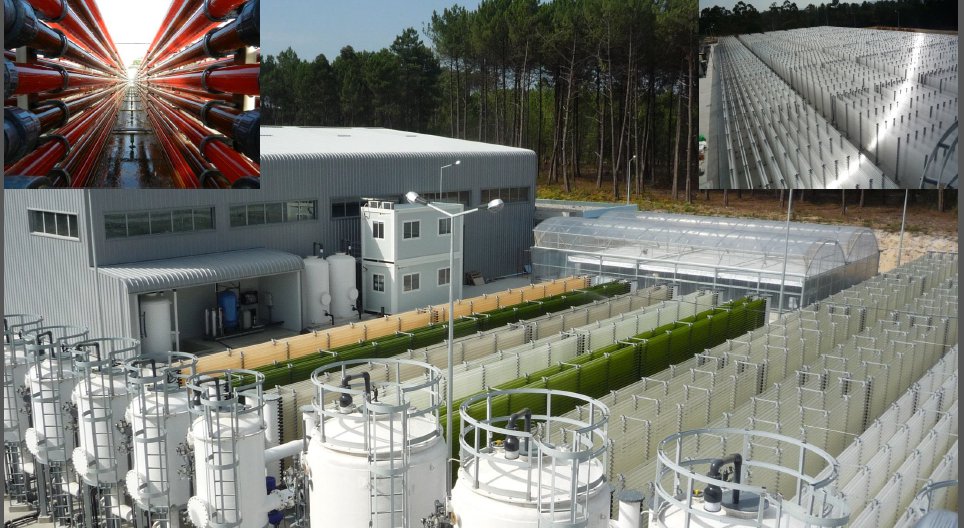
Algae biofuel facility in Europe
One of the largest currently active microalgae production facilities using photobioreactors (250.000 gallons) in the world is this A4F / Secil in Europe.